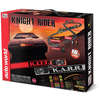
SCX 1:32 Scale Slot Car Racing
2007 - 10th Anniversary. Tecnitoys acquired the SCX brand in 1997, as well as over 35 years of slot car racing experience. They have built on this rich legacy through technological innovation, measurable improvements in product quality, and continued enhancements in customer service. Their strong passion for the slot car industry and motor sport world is easily identified throughout all the quality sets, cars, track, parts, and accessories available through now, which will continue to expand as Tecnitoys celebrates their 10th Anniversary and future plans.
In ways of Innovation Leadership, SCX has introduced xenon lights, tilting chassis, metallic bearings, adjustable/removable magnets, and automatic return guides with suspension on most cars. They also offer standard motors up to 19,000 rpm's - producing scale speeds in excess of 200 mph. And one thing that always draws a hobbyist's eye is the detail in the car bodies and tampo printing, all which are beyond compare throughout the F-1, GT, DTM, Rally, and NASCAR lines available.
With this, SCX has one major breakthrough during the past 10 years that trumps all others, the SCX Digital System. Tecnitoys was the first to launch a digital system and the only slot car manufacturer to introduce the Digital PowerLine. The Digital PowerLine allows the set to expand to great lengths and with numerous accessories without taking power away from up to six cars racing at the same time. The SCX Digital System is the most reliable, most complete with all the needed accessories, and the most realistic digital system on the market - most due largely to the implementation of the Pit Box strategy and years of experience with digital technology. Tens of thousands of digital sets have been sold to slot car hobbyists worldwide.
In terms of customer service, Tecnitoys now maintains product inventory throughout the year in Europe, North America, and Asia to meet the demands of enthusiasts. They have further invested heavily in production capacity to meet the growing demand for their products - especially with commitments to get the new products into the market earlier in the year to help with shortages and bought-up supply when it comes time for the holiday season.
SCX's effort to deliver excellent products and meet consumer demand has been recognized internationally by winning the Duracell Toy of the Year Award in 2004, 2005, and 2006.
Check out the SCX Slot Cars category for all current cars, sets, and parts. As new products are released and available in the US, they'll be listed and available here.
Racemasters - Tomy - AFX HO Scale Slot Car Racing
Super G+ and the Current Era The performance standard in HO scale racing was set many years ago by the original G+ cars. Today, the Super G+ slot cars feature: high output precision wound armatures, Can motors, ground effects magnets, Tru-Trac racing tires, high conductivity pickup shoes, and micro spur gears. The Super G+ is the most raced, most often modified, and all-around fastest car on the market today.
The SRT Arrives These are super fast HO cars packed with features: neo dymium magnets, high torque gear ratios, non-disengaging pickup shoes, high conductivity shoe springs, ground effects, hot armatures, and Can motors. The SRT cars have been very popular since they feature a great combination of performance, reliability, and user-friendly handling. In 2001, Racemasters released the SRT Cobra Daytona Coupes which are a blend of modern era technology with a classic look and body style.
The Modern Era From the inline chassis configurations of the late 70's through the early 80's came the next step in HO slot car racing - the Can motor. The modern era chassis have an integrated Snap-In motor that is self contained in a combination canister/flux collector. The Can amplifies magnetic output and helps direct more of the grip to the track rails.
The modern Can cars typically feature rear inline Boost magnets that further grip the track rails. The commutator barrel, spring, and brush systems of the old inline motors gave way to a 4-slide stamped system offering more direct connection. Ultimately, they have hotter motors and better handling - they really rip around the track!
The G+ Arrives In 1976, Aurora came out with the Gravity Plus cars - G+. The G+ were 30% faster than the previous and all conquering Magna Traction cars featuring in-line high output motors, sponge tires, and much, much magnet down force. Slot car pioneer Jim Russell developed this car with a team of talented people including HO legend John Cukras - the future was now.
Since the G+, there have been many evolutions to the magnetic down force slot car. Most were developed by either Jim Russell or John Cukras for companies like Tomy, Tyco, Aurora, Life-like, and others. Today's SRT and Super G+ cars now feature Can-style motors, greatly improved bus systems, and incredibly realistic bodies.
Today's HO racing cars, while not true H.O. scale by previous standards, are nonetheless the most realistic, powerful, and fund to race cars ever produced. What was originally intended as an ornament for model trains quickly became a performance-based hobby all of its own. The current Super G+ cars and SRT cars are fast as a bullet, yet handle like they were on rails. The bottom line is that the modern HO scale slot cars have more play-value than anything ever before, and a great track can still be setup on a 4' x 8' slab of wood.
The AFX Era Arrives Aurora's AFX line changed the face of HO racing. The Aurora Factory Experimental cars were highly tuned racers that blew everything coming before them away. In 1974, AFX introduced the Magna-Traction line. This was the first use of the motor magnets which provided down-force to the track rails. Cars handled like a dream and racing HO cars started to become tons of fun.
The Thunderjet Era In 1963, the Thunderjets evolved. Hobbyists gladly jumped on the bandwagon of the T-Jet revolution which is when actual racing began forming in garages all across the world. Thunderjets featured a geared motor which was much more drivable then the old vibrator cars. T-Jets became more dependable with increased speeds. Thunderjet variations went on for some time which culminated with the AFX line in 1971.
The Early Era HO racing owes most of its roots to the model railroad enthusiasts. Back in the 60's, model railroaders wanted to have cars, trucks, buses, and other vehicles to drive on the streets of their detailed model train layouts. The beginning of H.O. slot cars featured marks such as the Playcraft Electric Highways sets that evolved into the Aurora Model Motoring sets.
The early cars featured a motor configuration called vibrating motors. They were propelled by a vibrating reed that turned a drum shaped gear, which is what propelled the cars forward. They buzzed around the track at a low rate of speed slim hard rubber tires. The lack of traction created an over-steer condition usually followed by a flip-over, which led to much frustration when trying to win a race.
The cars were not very reliable and almost impossible to work on. This in turn led to much frustration and a lack of the post important thing - speed. The key element for this new and growing hobby though was the ease of setup. HO tracks can be setup on a 4 x 8 foot piece of plywood and raced when time allows. When done racing, the whole track and layout could then be taken down and stored away. This one fact led HO car racing away from being a support mechanism for model train layouts to a stand-alone hobby all in its own.
HO trains are 1:87 scale, so all early slot cars are the same. As time went on, three things became clear:
- The HO scale cars originally designed more for decoration than performance began being raced.
- To make cost effective and better working car that could actually be worked on, the size had to be slightly larger. Also, the motors and parts available simply did not lend themselves to fit within this 1:87 scale size.
- It was very difficult to make realistic looking bodies given the constraints of the chassis components. Also, the cars were so small that many hobbyists had difficulty even seeing or creating the detailed marks, logos, and unique identifiers.
To combat these issues, a few key early pioneers took the original design ideas and started to change a few things. The ironclad 1:87 scale soon gave way to slightly larger cars - still not near as large as the 1:24 scale or 1:32 scale slot cars that dominated in the 60's, but the modified HO scale cars became very popular. These size adjustments changed the scale from 1:87 to an era roughly between the 1:50 and 1:72 scales today.
Today, Indy type cars are usually a little smaller and closer to 1:72 scale, while most of the stock cars are larger Group-C type cars that tend to be larger and close to the 1:50 scale size. Over the years, attention shifted more to performance and handling instead of actual adherence to strict scale format. As the hobby came into its own sector and separated from model trains, the consumer desires also changed.
|